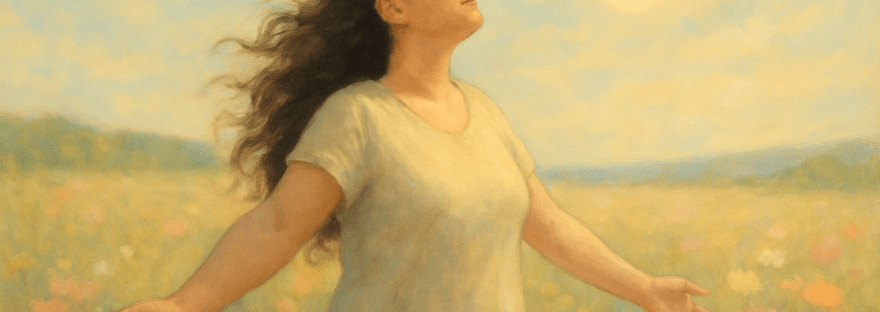
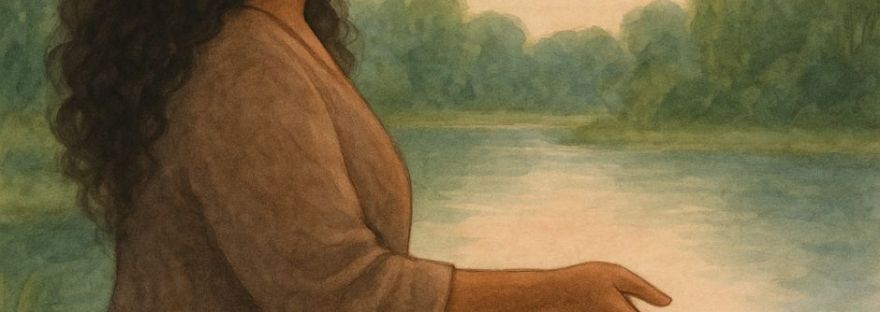
We look for reasons to love others, to want to be close to them—certain character traits, similar life circumstances, their opinions—and this is natural, normal, understandable, and very limiting. What if we could love others even without these labels? What if we had the ability to see beneath immediate judgments, to be able to gently be with every expression that appears before us?
Tag: happiness
The Other Way Around: A Journey to the Mind and Its Reflections
Within the quiet of the retreat, the mind begins to observe itself. Our stories about the people in our lives rise to the surface, but contrary to the automatic response, we see them not as absolute facts but as projections of our consciousness. It's a moment of powerful discovery: when we see someone who annoys us, within seconds we recognize how we act in the exact same way. This realization turns our world upside down.
Changing Habits from an Angel’s Perspective
Changing Habits from an Angel's Perspective We're all familiar with it: we carry a certain habit with us for years. Maybe it's a pattern of procrastination, unnecessary eating in front of a screen, anger that erupts at the wrong moment, or an inability to let go of a small addiction. We try again and again to change—sometimes by force, sometimes gently—yet we find ourselves returning to the same place. From a typical point of view, bad habits seem to prove something about us: that we are weak, not good enough, or lack discipline. But there is another way to see things—a compassionate, profound, and surprising way.
Why Occupying Ourselves with Others Causes Suffering, and How to Turn Inward
The moment we occupy ourselves with things that are not our own, trying to take responsibility for what is not in our control, we are essentially investing energy in a barren field. The common mistake is to think that busying ourselves with others' affairs grants us control, when in fact, it strips it away. Instead of managing my own life, I am living within the movie I project onto them. The result: worry, comparison, self-criticism, and the very detachment from life itself.
Am I allowed to feel relief – even when something didn’t work out?
To conclude the series on ‘Accepting What Is’, we will talk about this place where the heart knows something that the head has not yet agreed to hear: That something is over – and that’s okay.
Does acceptance mean giving up my expectations from life?
acceptance does not contradict aspiration. On the contrary – it allows us to want without fighting. To want from a place of freedom. Without grasping.
How do I know if I am accepting – or just repressing?
A sensitive question: “How do I know if I am accepting something – or just closing my eyes?” Acceptance of reality as it is does not feel like disconnection. It feels like breathing. Like presence.
So what, just let go? Even when it is important to me?
Sometimes letting go seems like weakness. As if we are leaving something that is supposed to be important to us. But letting go is not giving up – first of all it is an open question: Am I still holding on to it – because it is alive in me, or because I am afraid to let go?
If I accept what is – how will I change?
“But if I just accept what is – how will things change?” This is a great question – because it reveals our deepest dilemma: If I don’t fight, I might stay stuck. But true acceptance is not giving up – it’s a beginning.
An Experience of Life Already Fulfilled – An Invitation for an Inventory
One of the most important spiritual practices is the practice of awareness of death. Sorry for the dramatic opening, but it's true. And if we're lucky, we'll live a long enough life to look back and ask ourselves: "Did I live a life worth living? Did I fulfill myself?" Each of us has different definitions of what a "life worth living" is, and that's perfectly fine, as long as we are sure that indeed, these are our definitions, which we have tested and explored with awareness and we have decided that they are right for us, and not because we have adopted what our society has dictated to us, without daring to even put a little question mark at the end. So the invitation this time is to bring forward this death-bed retrospective evaluation of my life, and so I can relate to each night when I go to sleep as a kind of small "death", before which I make the same retrospection, and recognize everything I have achieved until today. And the next day, a new day, we do it again.